
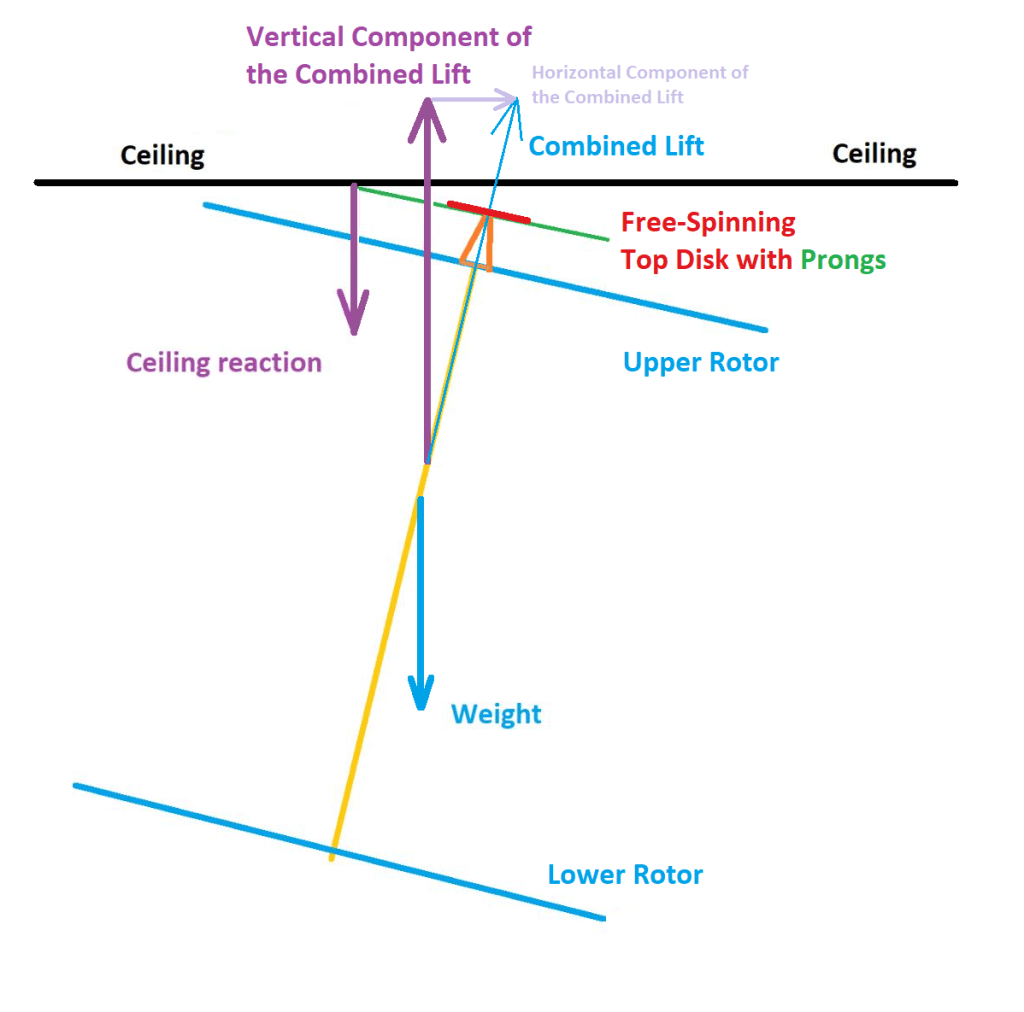
The top, free-spinning disk on a Science Olympiad (SO) helicopter—or the four prongs as seen on some winning designs—plays a critical role in maintaining stability as the helicopter stays under the ceiling.
Here is a sketch that illustrates how these four prongs (or a bigger disk) contribute to a positive stability at the ceiling. As shown in the drawing, when the disturbance is within a threshold, the ceiling reaction and the combined lift form a positive restoring torque that pushes the helicopter back toward a level and stable orientation.
Without such prongs or a bigger disk, the helicopter is prone to wobbling, or topping-over, when the disturbance exceeds a critical threshold.
Key Takeaway: To maximize stability under the ceiling, focus on maximizing the area of the free-spinning disk or prongs while simultaneously ensuring a low Center of Gravity (CG). Don’t use heavy balsa wood for the disk or prongs! Heavy components at the top raise the CG above the Center of Lift, leading to an unstable helicopter that will likely never reach the ceiling.
Next: Sketch a similar diagram but include a top vane, placing the resulting Center of Pressure (CP) higher than the Center of Gravity (CG). Check to see if you agree that this top vane actually hurts stability when there are horizontal air currents blowing from the side (left.) (Search Google for “Rocket Stability” to better understand the relationship between the Center of Pressure (CP), Center of Gravity (CG), and the direction of movement. )
-AeroMartin 9/25/2025
 StarImagineering
Leave a comment