

If you’ve ever coached or flown in Science Olympiad Flight, you’ve probably seen this pattern: a student gets one amazing flight, celebrates, and then spends the next ten attempts wondering why nothing comes close. The problem usually isn’t the helicopter. It’s the difference between precision and accuracy, and understanding that difference is the key to consistent improvement.
Accuracy is how close you are to the goal. Precision is how consistently you can repeat the result. Without precision, accuracy is nothing more than luck. You might get one great flight, then spend weeks wondering why you cannot repeat it. The real path forward is to build precision first. Once your flights become consistent, accuracy naturally follows.
A helpful way to visualize this is the dartboard analogy. Accuracy is hitting the bullseye. Precision is landing all your darts in the same tight cluster. SO Flight works the same way. It is a skill built on muscle memory, and muscle memory only develops through steady, deliberate practice.
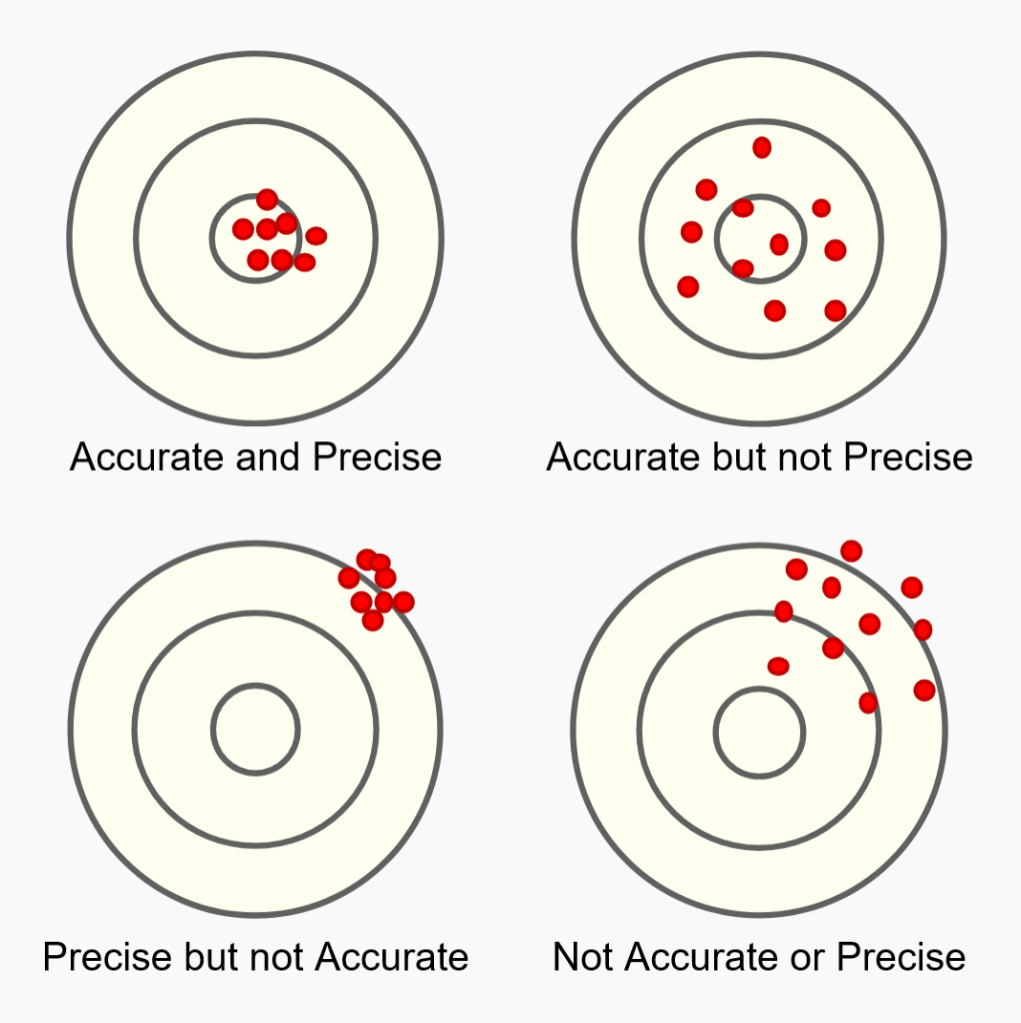
Why Precision Matters More Than Accuracy at First
Precision is the backbone of competitive success. Small variations in rubber band stretching, launch torque, posture, or handling can add up quickly and create confusing flight behavior. This is why students often ask, “Why can’t I reach my record time again?” A well tuned helicopter should produce flight times that fall within ten seconds of each other, or twenty at most. If your flights vary more than that, the issue is almost always inconsistency in your process, or mechanical degradation of the aircraft (see the Addendum below for details).
To build precision, keep every variable the same as during your best flight:
- the same rubber size
- the same winding method
- the same max torque
- the same hook and unhook technique
- the same steps to the launch spot
- the same breathing(!) and release posture
When the details stay consistent, your flights will too. Repeatability comes first. Accuracy and long flights follow.
How to Build a Repeatable Flight Routine
Start by choosing a reliable helicopter and reviewing its flight log. Identify its best performance, ideally 2 minutes and 30 seconds or longer, and make that your target time. Your goal is to reproduce that flight time as closely as possible.
Treat the entire launch sequence like a sport routine. Use the same rubber band if possible, pull with the same force, walk in with the same number of winds, stand in the same position, count down with the same tone, and release with the same posture and torque. SO Flight truly is a sport event, and with enough practice, you should be able to match your record within a few seconds, three times in a row!
My past teams all reached that point. When they walked into Regionals or States, they already knew their target duration. For airplane events, the trim flight and the official flight were nearly identical, except the official one was always better!
Coaching Questions That Improve Flight Performance
During practice, I use a simple question cycle that helps students think like engineers.
1. Before the Flight: Identify Intent
“What did you change, and why?” Every adjustment should have a purpose.
2. During the Flight: Observe Symptoms
“What did you see?” Students learn to observe symptoms, not guess. Real examples include:
- ascending too fast
- shaking
- not stable
- walking on the ceiling
- wobbling
- RPS dropped too fast
- “Much better, it is staying in one spot.”
- “That’s clean.”
- “Wow!”
And from a record breaking 3:56 flight: “Wait, why is this such a good ascent?! That’s clean! All right, Double Fishbone, run it!!”
3. After the Flight: Choose One Adjustment
“What will you do to correct what we just observed?” Students identify one issue, connect it to the most influential change, and consider any side effects that change might bring. This habit builds engineering discipline and prevents random, unfocused tweaking.
A Simple Practice Strategy for Steady Improvement
At the start of each session, I ask students to set a target flight time, perhaps fifteen seconds above their previous best. Sometimes they hit it, sometimes they do not, but the goal keeps them focused and encourages steady improvement. Over time, this mindset builds both precision and accuracy, and that’s when the longer and longer flights start to appear.
Using Multiple Helicopters to Accelerate Learning
Another powerful habit is flying two or more helicopters during the season. Think of the second one as your experiment platform. Use it for pitch tweaks, balance changes, or any adjustments you are not ready to try on your main flyer. If the test helicopter starts outperforming your primary one, that is great. It becomes the new leader. Then you can bring those same improvements back to the original and push it even further. Rotating through two or three helicopters like this creates a steady cycle of learning and improvement, and it ensures you always have a top performing helicopter ready when you need it. Over time, that reliability builds the confidence that carries students into competition ready for their best flights.
Final Thoughts: Trust the Process and Keep Flying
So keep practicing, stay curious, and trust the process. Every flight teaches you something, and every small improvement adds up. Precision builds confidence, confidence builds accuracy, and accuracy builds those unforgettable record breaking moments.
You’ve got everything you need to get there, now go make the next flight your best one yet! Good luck! See you all at 2026 USC National!
-AeroMartin 01/28/2026
Addendum: Mechanical Precision vs. Pilot Precision
While the article above focuses on human consistency, mechanical consistency is equally vital. You can have a perfect launch routine, but if your aircraft is physically changing between flights, your precision will vanish.
Common consistency killers like worn out nose bearings, weakening rib joints, or distorted blade pitch angle often happen so gradually that you might not even notice them. This is why I recommend a periodic mechanical health check. Sometimes students are just too close to the model to see the fatigue. Having a second pair of eyes, whether it is a teammate or a coach, can reveal issues you might have missed.
I encourage my students to take close up photos of their helicopters and record clear videos of their flights. Slow motion is especially helpful here. Use those photos and videos to get a technical health check from your coach or a teammate. When your aircraft becomes as reliable as your routine, that is when the record breaking flights really start to happen.
The Staged Approach
I always advocate for perfecting building and flying before diving deep into design. If you cannot build a robust and repeatable aircraft, you cannot accurately test a new design feature. For a phased approach on mastering these fundamentals, you may refer to my Helicopter Roadmap: Where Are You Now, over at Thingiverse.com. It outlines the path to ensuring your mechanical platform is every bit as precise as your launch routine.
(Published: 02/23/2026)
 StarImagineering
Leave a comment