
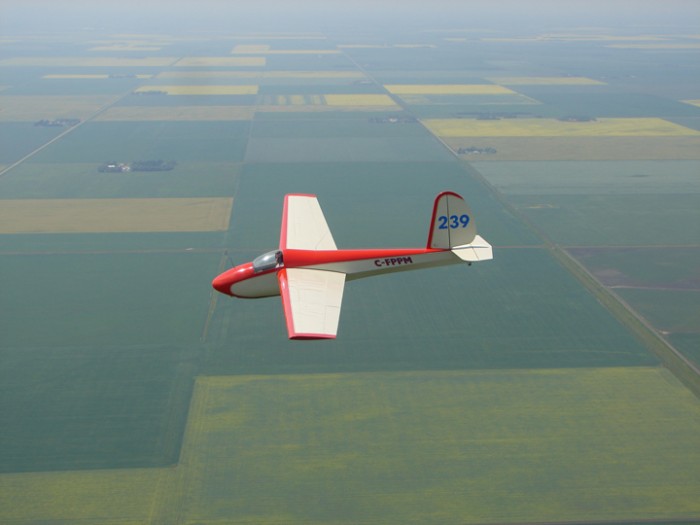
Aspect Ratio (AR) is a fundamental measure of wing geometry and a key driver of aerodynamic efficiency. To understand it simply, think of it as the skinniness of a wing or a helicopter blade. It is the relationship between the span (length from tip to tip) and the chord (width from front to back).
Formally, aspect ratio is defined as:
- For rectangular wings:
- For any wing shape:
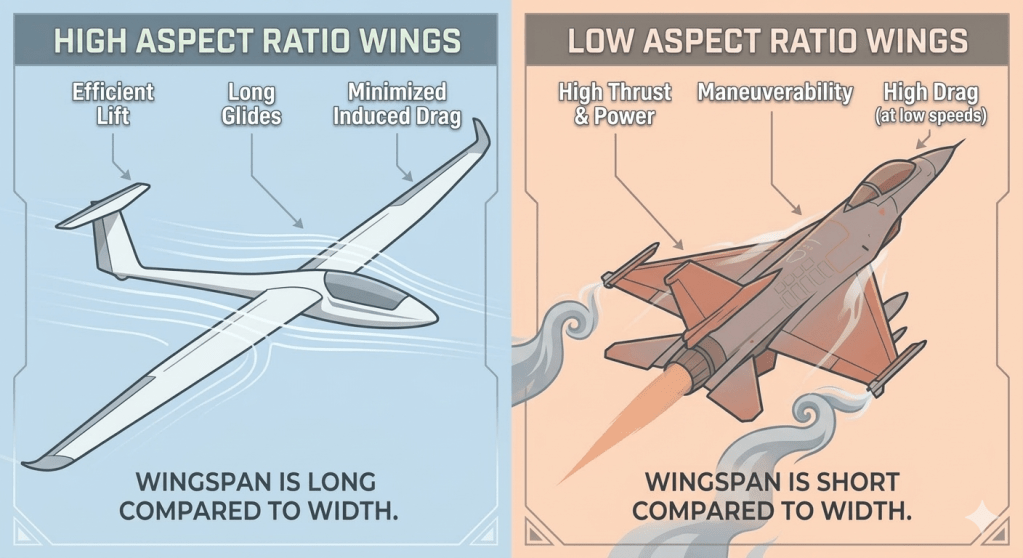
A long, thin wing, like you would see on a high-performance glider, has a high aspect ratio. A short, stubby wing, like on a fighter jet, has a low aspect ratio.
The “Leaky” Wing Tip
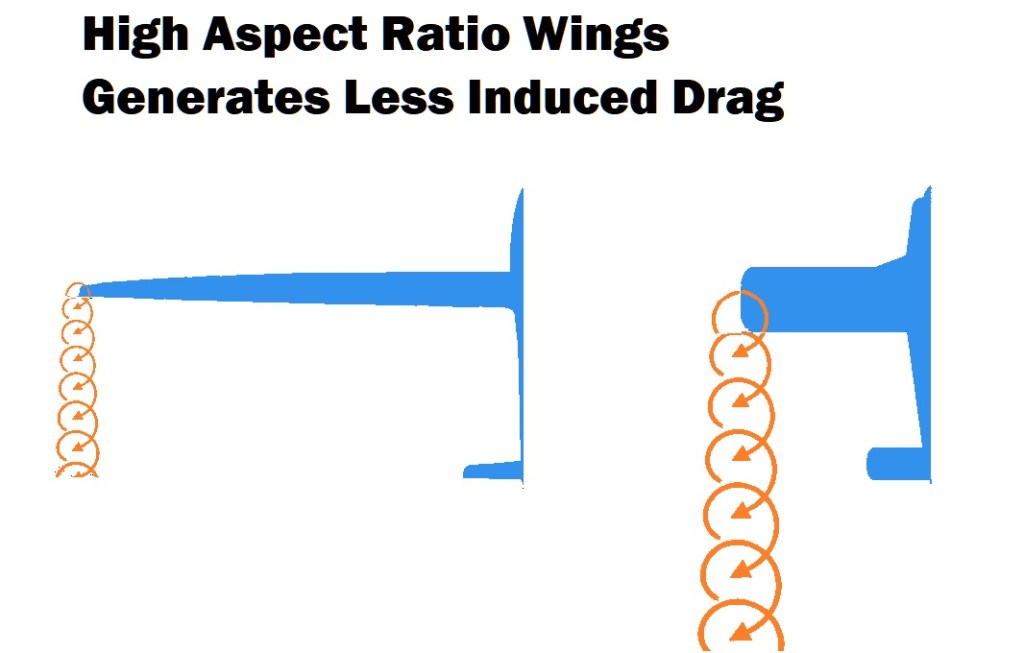
The secret to wing efficiency lies in what is happening at the very tips. When a wing creates lift, you have high-pressure air underneath and low-pressure air on top. Nature hates a pressure difference, so that high-pressure air is constantly trying to leak around the wingtip to get to the low-pressure side.
This creates a swirling tunnel of air called a wingtip vortex. These vortices are essentially drag. They are a waste of energy because the wing is spending effort spinning air in circles instead of just pushing the aircraft up.
Why Long and Skinny Wins
Efficiency is all about reducing that waste. On a high aspect ratio wing, the tips are very far apart, and the leaky area is small compared to the rest of the wing. Most of the wing gets to do its job of creating lift without being bothered by those messy swirls at the ends.
On a short, wide wing, a much larger percentage of the wing is affected by the tip vortices. It is like trying to carry water in a bucket with a hole in the side; you can still reach your destination with a full bucket, but you have to pour in extra water to make up for the leakage just to keep the level steady.
Science Olympiad Constraints and Design Compromise
In Science Olympiad flight competition, you cannot simply make the wing as long as you want. The rules usually put a strict limit on the maximum wing span or rotor diameter, as well as a minimum weight requirement. These constraints force a difficult choice regarding aspect ratio.
If you push for a very high aspect ratio within a fixed span, the wing becomes incredibly narrow, resulting in very little wing area to generate lift. If you go too low with the aspect ratio to get more area and lift, you suffer from high induced drag. Ultimately, aircraft design is a compromise; you must find the sweet spot that balances lift, drag, and structural weight within the rules.
The “Wingtip Plate” Myth
You might see some planes or helicopters with vertical plates at the tips and think they look efficient. However, simply adding a plain, right-angle plate to the end of a wing usually does more harm than good. Instead of stopping the leak, it often just creates interference drag, which is extra air friction where the plate meets the wing.
Unlike a simple wingtip plate, a true winglet is a carefully engineered “miniature wing.” Designing a functional winglet that actually reduces drag requires hundreds of hours of complex computer simulations (CFD) and wind tunnel testing. To work correctly, a winglet must be precisely twisted and angled to interact with the local airflow; otherwise, it simply adds weight and parasitic drag without assisting lift at all.
See why modern wing designs prefer streamlining over abrupt wingtip plates here: From 3 Minutes to 4.
A Note on Washout
To help manage how air behaves across the wing, designers often use washout. This is a slight twist built into the wing so the tip is angled lower than the root. This helps ensure the wing remains stable and that the leaky air at the tips does not cause the aircraft to stall or tip over unexpectedly.
For a quick introduction to the definitions and a graphical look at how washout flow works, you can find more info here: Beyond Pitch Perfect.
Putting It All Together: The 2×2 Long Blade Advantage
Understanding the delicate balance between aspect ratio, induced drag, and competition constraints is what separates a good design from a great one. By utilizing a 2×2 long blade short stick configuration, you can actually take advantage of a larger aspect ratio than a traditional short blade long stick setup can offer, giving your rotors a distinct edge in aerodynamic efficiency while staying within the rules.
To see exactly how this 2×2 long blade configuration works and the trade-offs involved compared to other setups, check out this deep dive: Optimizing 2×2 long blade Helicopter Stability: Key Design Insights.
Cheers!
-AeroMartin 3/15/2026
 StarImagineering
Leave a comment