
This post is for advanced flyers who have completed the three stages of their journey. If you haven’t yet, check my [Where are you now? Helicopter Roadmap] to review the basics and ensure you’ve achieved Stage 3 before attempting this pitch tweak.
Congratulations! You’ve mastered the building basics—your helicopters are accurate and square. You’ve also perfected stretching the rubber band, reliably getting the maximum possible winds, and flight time, consistently.
You know you’ve successfully completed the first three phases and are now advancing to the highest stage of your helicopter journey.
Despite your beautifully built helicopter performing consistently well, you want it to fly even longer! But how?
Pre-Flight Check: Confirming Maximum Efficiency
Don’t change Pitch yet. Before changing pitch, let’s review a few things.
- Re-check the build: Ensure your helicopter is built to its absolute best. For example:
- No lingering covering material (see my “Zero to Gold” post).
- No weak joints.
- All aspects of the helicopter, esp. blades, are truly aligned and well-balanced.
- Review your flight log: Confirm that all flying best practices are being applied, such as achieving the maximum number of winds and the best launch torque.
- Optimize the rubber band: We need to select a rubber band size that is small yet sufficient to achieve the longest possible flight.
In short, make sure you have achieved what the designer of your helicopter intended.
Diagnosing Pitch Potential
You might be asking, “What pitch is the best?” My response is always: What are you seeing in the air?
Consider these questions:
- Is the helicopter ascending fast—perhaps too fast?
- Do the two rotors have a high RPS (revolutions per second) compared to other similar, winning helicopters?
- Is the RPS at the moment it leaves the ceiling significantly slower than it was at the launch?
If the answers are “yes” to all of these, your helicopter has the potential for a longer flight, and it’s time to consider a pitch change.
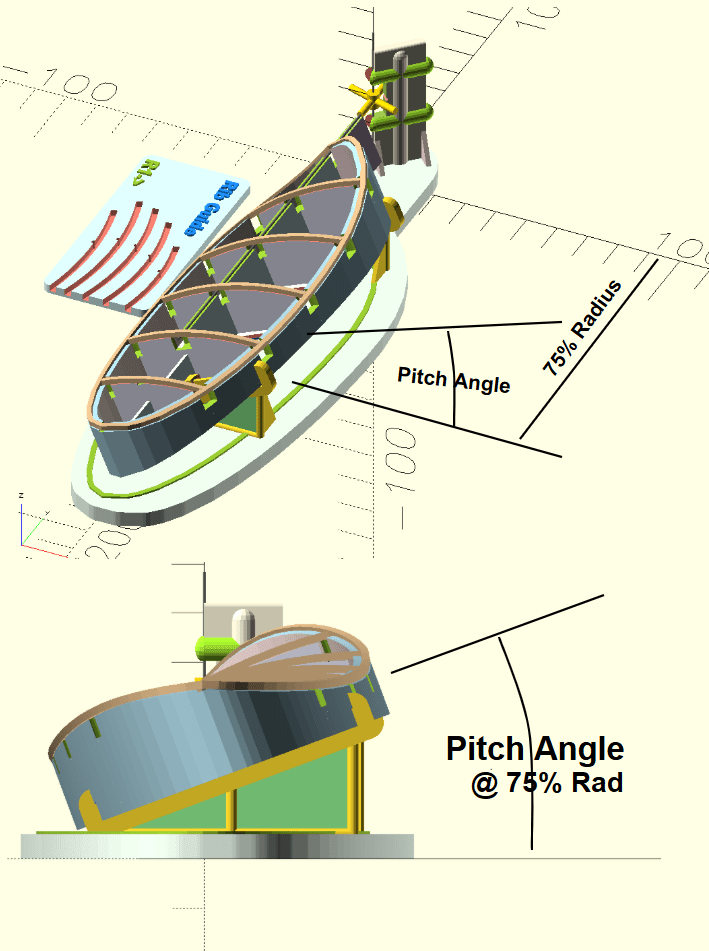
Before we proceed, note that the measurement location for ‘Pitch’ on a blade can vary (e.g., at the blade root, tip, or a standard radial station), and there are several ways to adjust it, such as adding washout without completely rebuilding the blade. We will discuss these different definitions and various tweaks in a future post. For the purpose of this article, we are focusing on the general concept of tweaking the overall set Pitch.
Tweaking the Pitch
If all the checks above are fine, it’s time to try reducing the pitch—a little bit at a time. But why smaller?
The Goal: We want the rotor blades to fly at a smaller Angle of Attack (AOA). This typically means less drag and better efficiency.
The Catch: While less pitch is more efficient, the rotors will turn faster. This faster rotation actually generates more lift (check the LIFT equation). This can make the initial launch phase too vivid, or even wild. (See my Vane Or No Vane Stability discussion.) Even if it’s mild enough to launch, allowing the rubber band to turn faster will use up its limited winds more quickly, thus shortening the flight. This is the opposite of what we want!
The Real Strategy
Let me clarify the approach. We reduce the pitch to achieve a smaller AOA, less drag, and better efficiency. But the crucial next step is to then adapt the rubber band.
The longest flight is the goal. Tweaking down the Pitch, followed by adapting a narrower/lighter rubber band, is the combined action that will help prolong the flight.
Optimization is Essential
Note: Reducing the pitch and changing to a smaller rubber band will not automatically give you your longest flight. It requires a new round of optimization to realize the maximum flight time.
You need to find the new best settings for all variables. (See my “Optimization Essential” post.)
While optimizing, always keep the rubber band torque-wind curve in mind (check the diagrams in the Roadmap). This curve, along with the minimum torque value needed to keep the helicopter afloat, will prevent you from using a rubber band that is too narrow or too light.
Record Everything
- Keep filling in your flight log.
- Ask a partner or parent to record all flights.
Your neat recording effort will pay off in a big way!
Consider sending your best flight video and flight log to a knowledgeable mentor for review. It’s amazing how much a full flight video can reveal and help you realize your helicopter’s best potential.
I’m always open to different approaches! Your innovative idea is what counts! Feel free to comment below, or send me an email, especially when you have a better approach. Share yours—the SO Flight community will thank you for it!
Good luck to all! Cheers!
-AeroMartin 11/11/2025
 StarImagineering
Leave a comment