
When designing and trimming a rubber-powered model airplane, every second in the air counts. To get maximum flight duration, you need to master the invisible force working against your aircraft: aerodynamic drag.
Drag isn’t just one single force—it is made up of two distinct components that fight your plane in completely opposite ways:
- Parasite Drag (Dp): The resistance created as the airframe pushes through the air. It includes skin friction over the balsa and covering film, plus form drag from the fuselage stick, prop shaft, and wing edges. The faster your plane flies, the higher parasite drag gets.
- Induced Drag (Di): The drag penalty paid to generate lift. As air flows over the wings, high-pressure air underneath leaks around the wingtips to the low-pressure area on top, creating swirl patterns called wingtip vortices. The slower your plane flies (requiring a higher angle of attack to stay aloft), the higher induced drag gets.
The Crossover Point: Finding Minimum Total Drag
Because parasite drag increases with speed while induced drag increases at slow speeds, total drag forms a classic U-shaped curve.
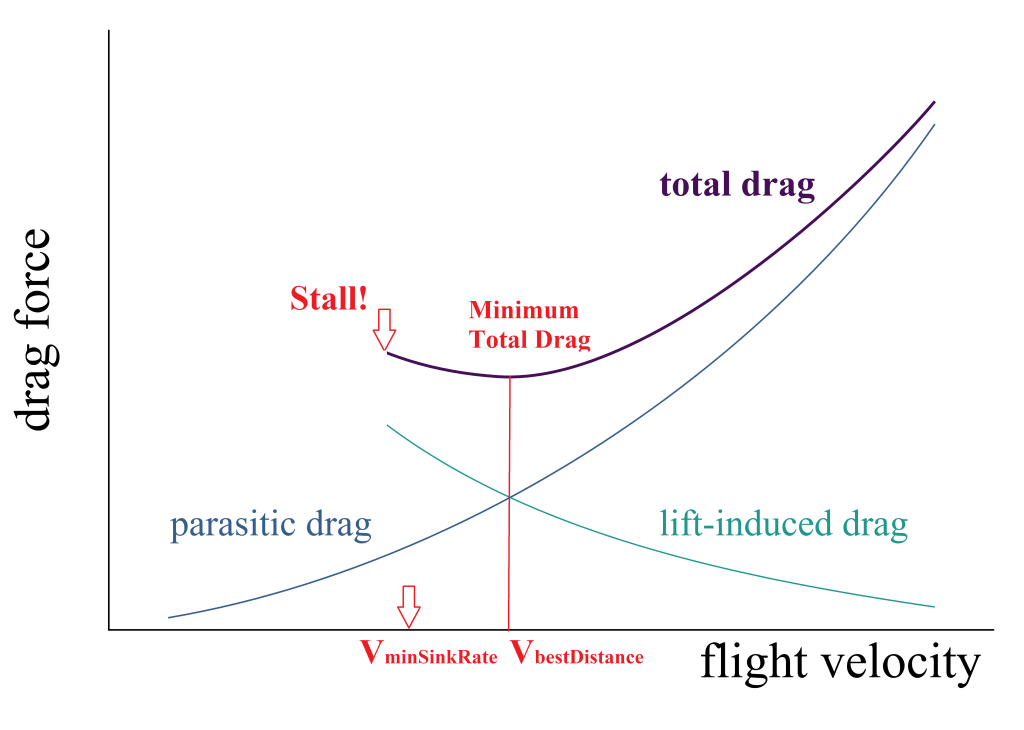
Think of it as balancing two different penalties:
- Fly too fast, and parasite drag eats up your motor’s precious energy just pushing air out of the way.
- Fly too slow, and the wing tilted back at a steep angle creates massive wingtip vortices, dragging the plane down.
The absolute lowest total drag occurs at the exact crossover point where parasite drag equals induced drag (Dp = Di). This is the ideal speed if your goal is maximum gliding distance.
Target Speed: Why Your Plane Should Fly at 76% of That Speed
For maximum distance (range), an airplane flies at the speed where total drag is lowest. However, Science Olympiad flight events aren’t about distance—they are all about maximum duration!
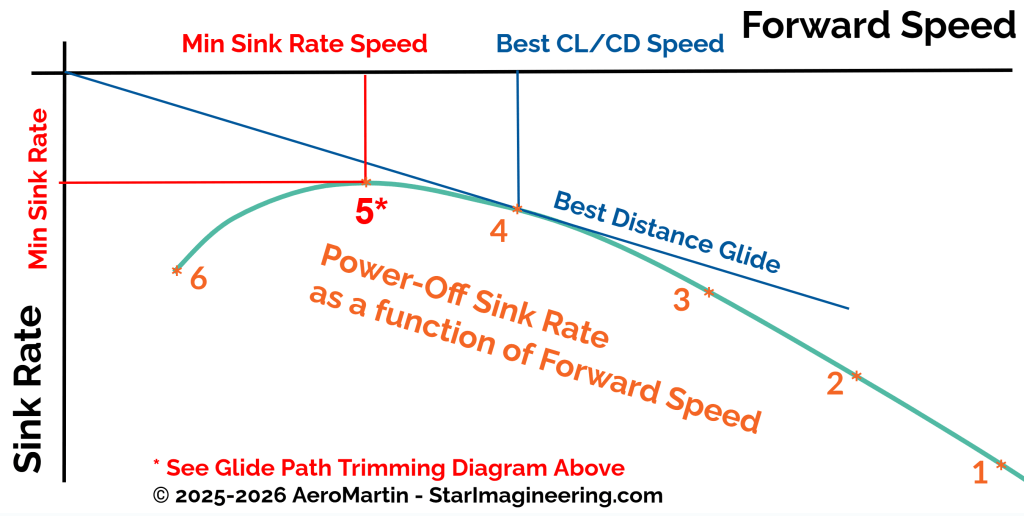
To keep your airplane floating near the rafters for every extra second, your aircraft must operate at its minimum sink rate speed (VminSinkRate) rather than its maximum distance speed (VbestDistance).
Through aerodynamic derivations, the airspeed for minimum sink rate comes out to:
VminSinkRate ≈ 0.76 × VbestDistance
This means the sweet spot flight speed for a Wright Stuff model is roughly 76% of the speed that gives maximum distance. Flying at this slower speed requires a higher Lift Coefficient (CL), which pushes induced drag higher than parasite drag, but it significantly slows down your descent rate and maximizes time in the air. See my previous optimal-speed-for-WS post for more.
F1D vs. Wright Stuff: Two Different Aerodynamic Worlds
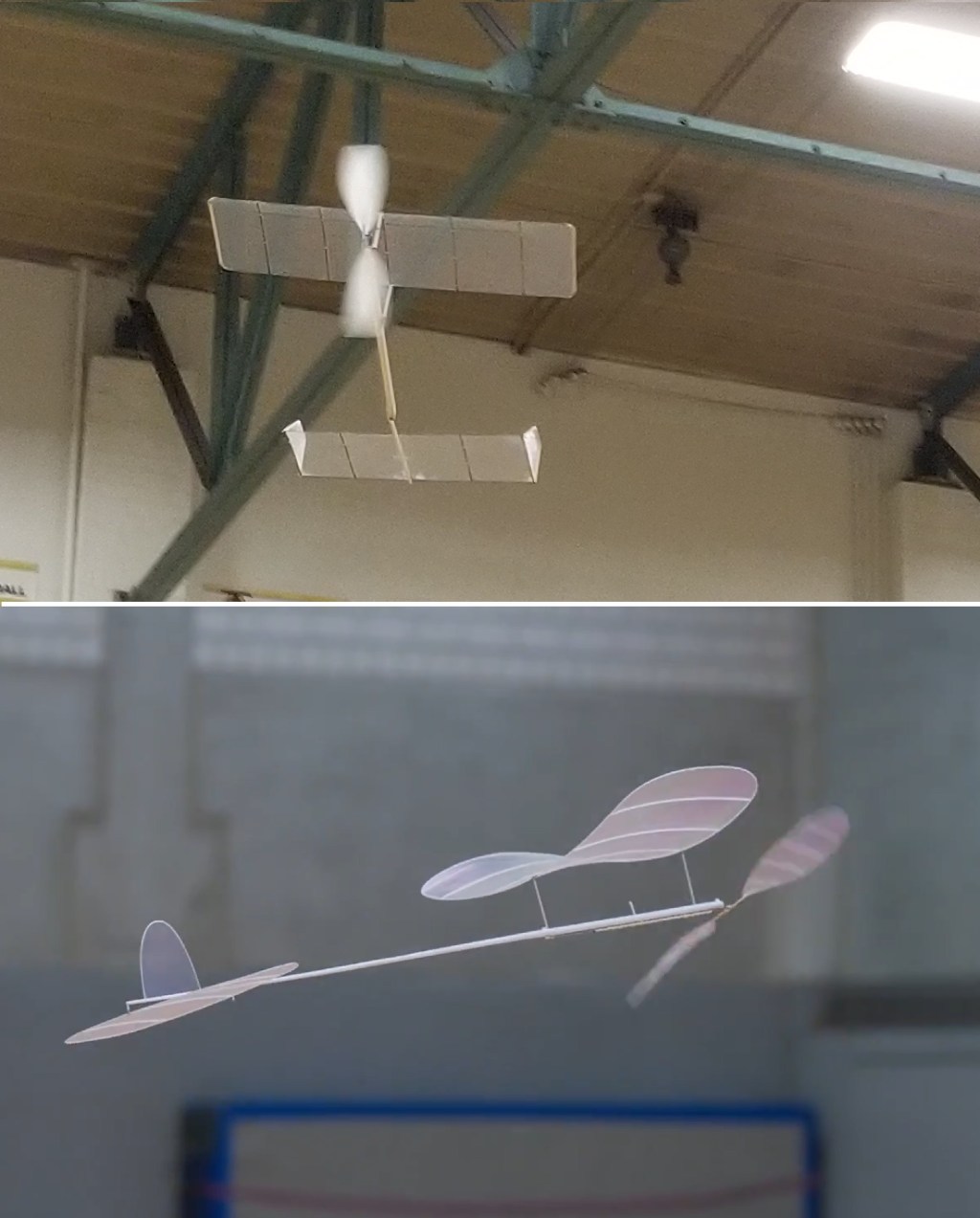
If you have ever seen videos of F1D airframes—the elite class of indoor duration models—you might wonder why Wright Stuff airplanes look and fly so differently:
- F1D Airframes: Weigh barely 1.4 grams with a massive 550 mm wingspan. Because they are ultra-light, their wings generate tiny lifting forces, meaning induced drag is almost non-existent. They float effortlessly at slow walking speeds.
- Wright Stuff Airframes: Rule sets require a much heavier mass (typically 7.0 to 8.0+ grams) and restrict wingspan (30 to 45 cm). Because a heavier plane must support more weight on a smaller wing area, Wright Stuff planes suffer from massive induced drag.
Every Wright Stuff builder is essentially fighting an induced drag battle that F1D flyers rarely face—making smart design choices all the more rewarding when your plane climbs smoothly to the ceiling!
Wright Stuff Core Design Considerations & Drag Breakdown
| Wright Stuff Parameter | F1D Reference Benchmark | Primary Drag Impact on Your Wright Stuff Design | Practical Design Takeaway for Science Olympiad |
|---|---|---|---|
| Minimum Airframe Mass (7.0g–8.0g+ vs. 1.4g F1D) | ~5x–6x heavier than an F1D airframe | High Induced Drag (Di). Lift must equal weight (L = W). Since induced drag scales with weight squared (Di ∝ W2), induced drag dominates your drag budget. | Build as close to the minimum weight rule as physically possible without sacrificing structural rigidity under motor torque. |
| Constrained Wingspan & Aspect Ratio (30–45 cm vs. 550 mm F1D) | Significantly shorter span and lower aspect ratio | High Induced Drag (Di). A restricted wingspan forces stronger wingtip vortices. | Maximize allowable wingspan and optimize wingtip geometry (such as an elliptical planform, subtle washout, or rounded tips) to achieve ideal lift distribution and suppress vortex strength. |
| Higher Flight Velocity (1.3–2.2 m/s vs. 0.4–0.7 m/s F1D) | ~3x faster cruising speed | Higher Parasite Drag (Dp). Higher speed increases skin friction (Dp ∝ v2). Additionally, adding flat wingtip plates increases interference drag, which is a major component of parasite drag. | Designing a streamlined airframe with no excessive protruding objects, smooth joint transitions, and no lingering covering film helps significantly reduce parasite drag. Lowering parasite drag reduces the optimal VminSinkRate, helping prolong total flight duration. Trim the aircraft to cruise at this exact sweet spot speed. |
| Heavy Commercial Plastic Propeller (Thick red plastic vs. ultra-thin F1D prop) | Thicker profile and fixed geometry | High Parasite Profile Drag (Dp,blade) & Excessive Weight. Heavy commercial plastic propellers (often red propellers designed for outdoor free flight) carry massive profile drag and rotational inertia that penalizes indoor duration. | Do not use heavy plastic props for indoor endurance. Build custom balsa blades formed using 3D-printed molds (like my OpenSCAD PropMold) to achieve light weight and true helical pitch. |
What This Means for Your Design Strategy
- Prioritize Induced Drag Reduction: Since induced drag (Di) is the largest energy drain on a heavy Wright Stuff airframe, focus heavily on wing efficiency. Aim for 6–8% cambered ribs and sufficient wing area with better lift distribution to generate strong, efficient lift at modest angles of attack.
- Precision Decalage & CG Alignment: Proper wing-to-tail decalage and CG placement keep the model cruising at that target minimum sink rate speed (VminSinkRate) without ballooning or diving.
- Maximize Airframe Streamlining & Eliminate Parasite Drag: Pay strict attention to airframe details that create unnecessary parasite drag (Dp). Focus on overall streamlining, avoid any unnecessary protruding objects like wingtip plates, and ensure all lingering covering film is trimmed flush. Keeping parasite drag as low as possible lowers your overall minimum sink rate speed and directly extends your duration.
- Ditch Heavy Plastic Props — Build Custom Balsa Blades: Heavy plastic propellers (such as red outdoor free flight props) absorb far too much rubber energy through blade profile drag and unnecessary rotational mass. Avoid them entirely! Instead, build custom lightweight balsa propellers using 3D-printable molds, such as the OpenSCAD PropMold tool on Thingiverse, which lets you generate custom true-helical blades tailored specifically to your motor stick and torque profile.
Taking Control of Your Aircraft’s Design
Understanding the physics of drag turns flight trimming from random guesswork into a deliberate, satisfying engineering process. When you build your own custom aircraft, every fraction of a gram saved, every smooth curve and corner, and every carefully trimmed wing alignment works directly in your favor to extend your flight times.
In upcoming articles, we will dive deeper into the hands-on engineering strategies that bring these concepts to life. There will be a dedicated post breaking down exactly why a 6–8% cambered airfoil is optimal for Wright Stuff airplanes, as well as guides on customizing high-efficiency propellers to extract every second of potential energy from your rubber motor. Keep experimenting, keep testing, and happy flying!
-AeroMartin 10/15/2026


Leave a Reply