
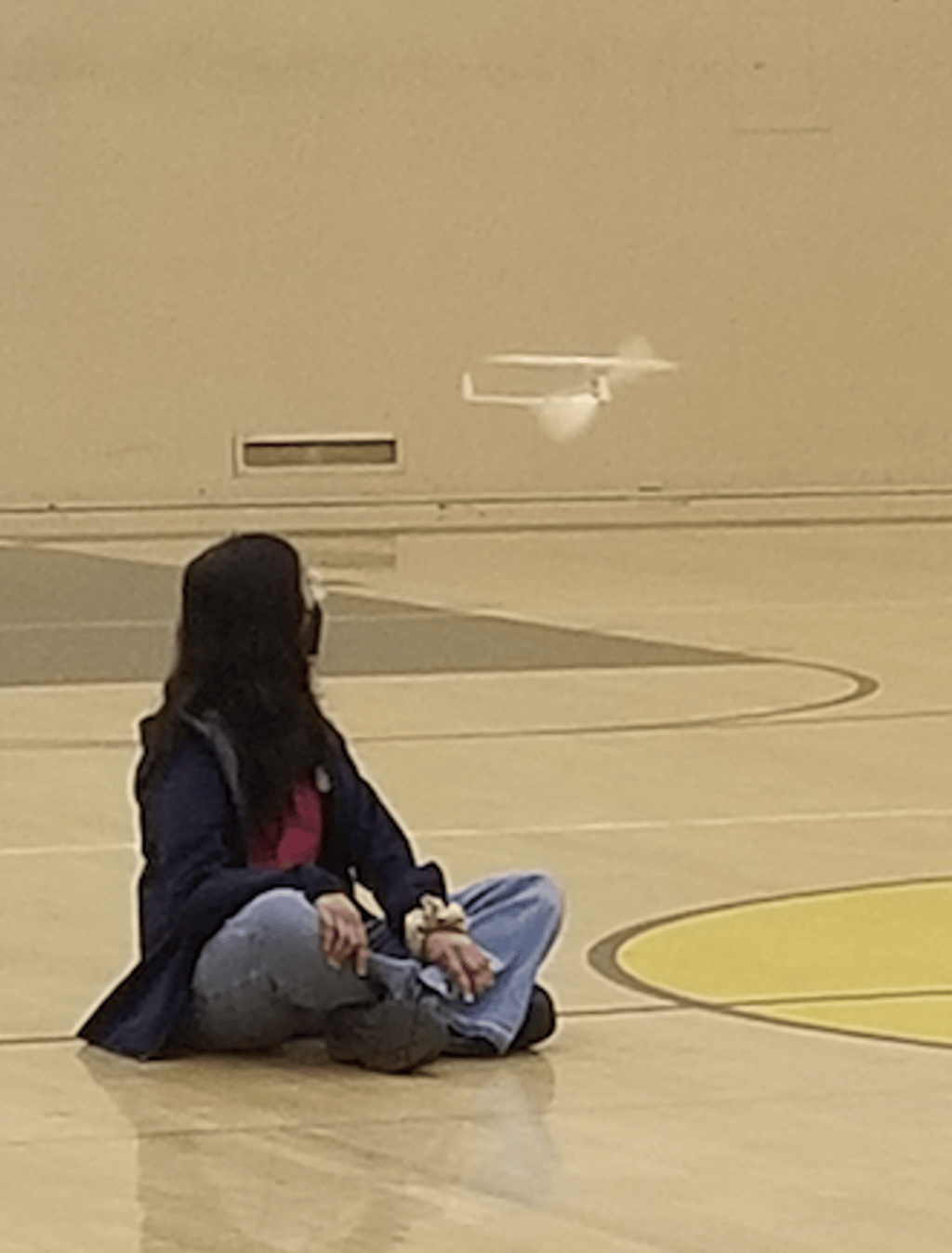
Watch a delicate Science Olympiad Wright Stuff airplane circle lazily beneath a gymnasium ceiling, and it can look almost effortless—a slender balsa-and-film frame floating through still air with no remote control and no pilot. Yet every second it stays aloft is a quiet demonstration of classic physics at work, from Newton’s first and second laws governing its circular path to careful aerodynamic trimming that keeps it from stalling or spiraling into the floor.
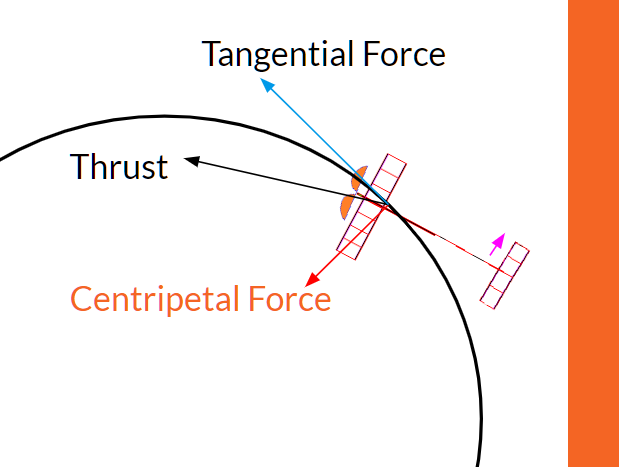
By Newton’s first law, the airplane would naturally keep flying in a straight line toward the gym wall, so it needs an inward pull—called centripetal force—to constantly bend its path into a continuous left turn. Newton’s second law shows that the size of this inward force depends on the plane’s mass, how fast it is moving, and how tight (small in radius) the turn is (Fc = mv2 / r). When you adjust the plane to fly in a smaller circle, its direction changes much more quickly, demanding a noticeably bigger centripetal force toward the center of the turn. To get that stronger pull, left propeller thrust (alongside effects like P-factor), left rudder, and wing banking—which tilts the lift vector inward—all contribute to curving the aircraft around a tighter path.
In practice, however, builders trim most indoor free-flight competition models to keep their wings nearly level rather than banking steeply. Because these airplanes fly so slowly in wide circles, the required centripetal force is small enough that left propeller thrust and rudder can handle the turn—leaving builders free to keep the wings flat in an event judged purely on maximum flight time, where giving up even a small fraction of aerodynamic efficiency is a real cost.
Keeping the wings nearly level brings three distinct advantages that directly translate into longer flights:
1. Preserving Vertical Lift and Stall Margin Within Design Limits
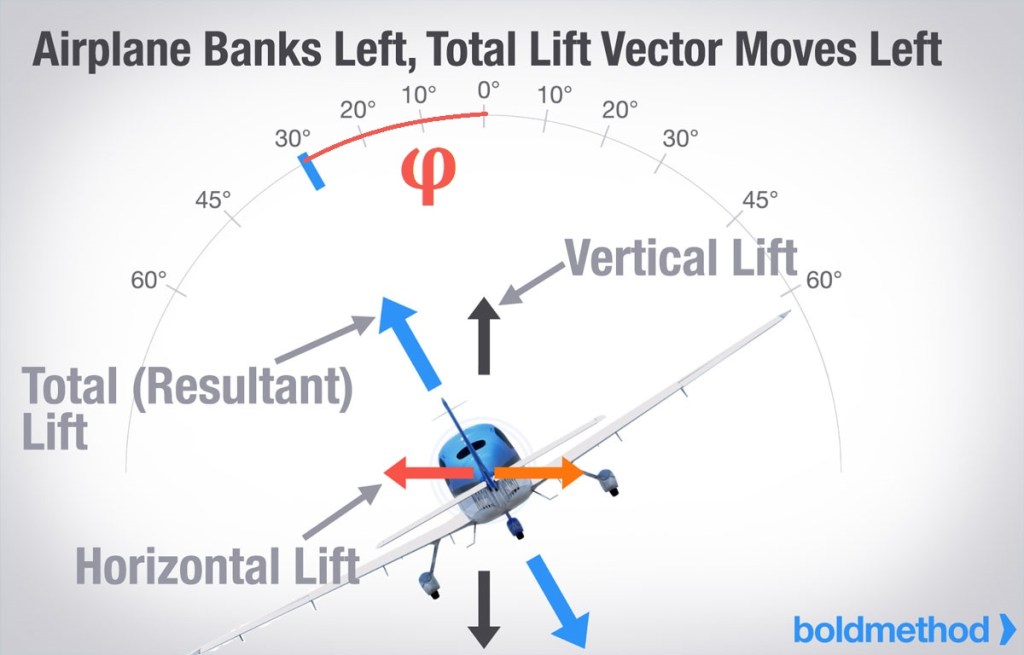
- Banking divides total lift: When an airplane banks at an angle φ, only the vertical component (L cos φ) supports its weight against gravity, while the horizontal component (L sin φ) pulls it inward.
- Design and rule limits cap lift margin: Under Science Olympiad Wright Stuff rules, the aircraft must fit inside a fixed measurement box, which indirectly caps available wing area—and several popular kit airplanes do not even maximize the full dimensions of that box, leaving them with even smaller wing areas. Combined with the finite maximum lift coefficient (CLmax) of lightweight indoor airfoils and tight weight budgets, some of these Wright Stuff airplanes have a high stall speed (Vstall) relative to their theoretical minimum-sink speed (VminSink)—a dynamic explored in more detail in Why Wright Stuff Isn’t F1D. If the wing stalls before the airplane can slow down to that optimal speed, it can never reach its minimum possible sink rate—meaning it leaves endurance potential on the table and has very little lift margin to spare.
- Level flight preserves vertical lift: Banking reduces vertical lift for a given lift force and forces the plane to fly faster—or push close to Vstall—just to support its weight, increasing drag and draining the rubber motor’s stored energy faster. Keeping the wing nearly level and using rudder trim and left thrust (alongside effects like P-factor) to establish a gentle turn keeps nearly all of the wing’s lift directed straight upward, protecting stall margin and minimizing sink rate.
2. Avoiding Spiral Instability Without Active Control
- Autonomous flight leaves no room for mid-air correction: Unlike radio-controlled or full-scale aircraft, an indoor free-flight model has no pilot or autopilot to correct bank or yaw once launched.
- Unchecked bank angles can spiral or stall: In a slow-flying airplane operating close to its stall angle of attack, a growing bank angle can trigger spiral instability or tip stall: as the aircraft turns, the outer wing moves faster through the air than the inner wing and generates more lift, while the inner wing moves slower and generates less lift. If yaw-roll coupling and directional stability are not balanced, the bank angle can steepen into a tight spiral dive. Keeping the wings nearly level—supported by wash-out (slightly lower incidence toward the tips) to delay tip stall—avoids an uncommanded roll-coupling loop and keeps the flight path predictable from launch to landing.
3. Balancing Rubber Motor Torque During Climb
- High launch torque pulls against climb stability: Immediately after launch, a tightly wound rubber motor delivers high torque that tends to roll the airplane counterclockwise as viewed from behind (to the left), opposite a clockwise-spinning propeller.
- Center rib offset balances roll moments cleanly: Builders deliberately offset the wing’s center rib toward the right so the left wing panel has a slightly larger span and moment arm than the right panel. That extra span gives the left wing more lift and a longer lever arm, creating a gentle clockwise (right-rolling) moment that counteracts left-rolling motor torque during the climb and helps stabilize a controlled left turn—keeping the wings nearly level without twisting either panel closer to stall.
In the end, winning an indoor endurance event comes down to balancing basic laws of motion against real-world design limits. Every tweak to propeller thrust, rudder angle, or wing geometry is an exercise in trading just enough inward force to stay clear of the walls without sacrificing the precious vertical lift that keeps the airplane floating until the rubber motor finally unwinds.
Every gym has its own quirks—drafts, low beams, or tight turning radii—and every builder has a slightly different trimming philosophy. How do you balance rudder, thrust, and wing geometry on your endurance planes? Tell us about your process in the comments!
Cheers!
-AeroMartin 11/21/2026


Leave a Reply